|
||
| |
12. Troilite droplets |
| Listing of Structures |
| Back...Next |
| Meteorite - N'Goureyma, ungrouped iron. |
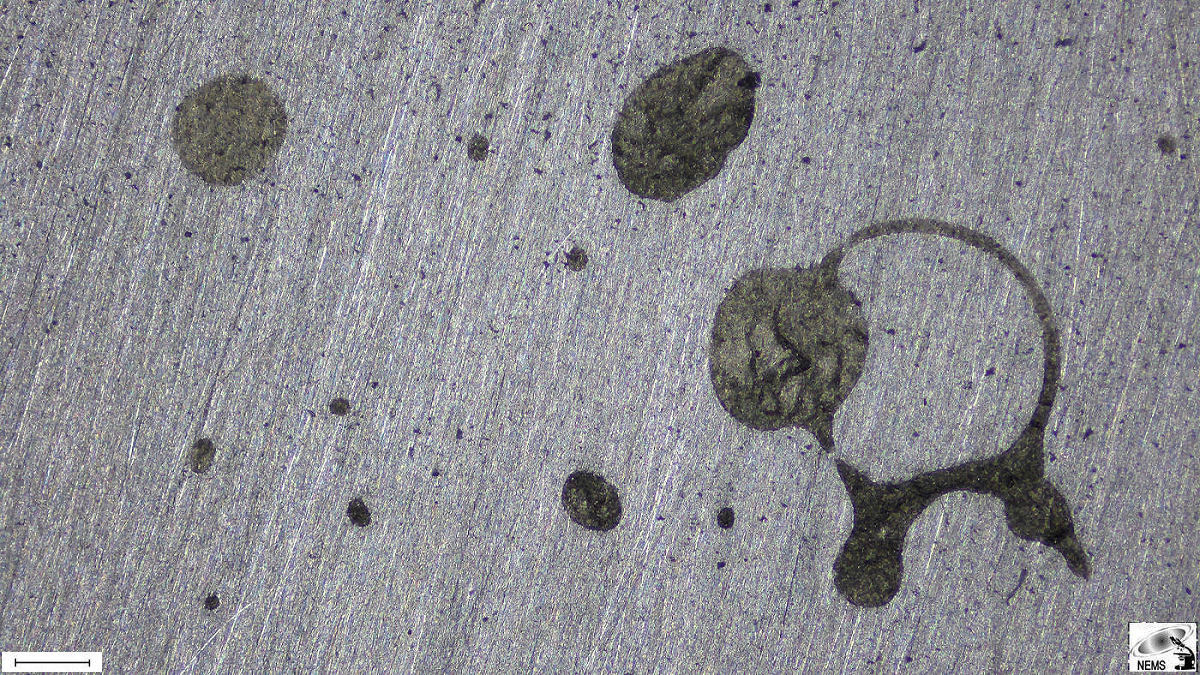 |
| Figure 1. Scale bar 600 µm. |
| Troilite droplets in the N’Goureyma iron meteorite. |
| N'Goureyma, Troilite Droplets. |
| N’Goureyma is a witnessed fall (June 15, 1900) from near Djenné, Ke Macina, Mopti Region, Mali. It is classified as an ungrouped iron meteorite (Iron, ungrouped), with a recovered mass of approximately 37.5 kg. This specimen is structurally anomalous and polycrystalline, distinguished by a reheated martensitic-plessitic matrix and an unusually high abundance of troilite inclusions. It lacks many features diagnostic of other iron meteorite groups, rendering it a valuable outlier for understanding diverse formation and evolutionary processes among metallic meteorites. Chemical Composition The bulk composition of N’Goureyma includes approximately 9.26–9.41 wt% Ni, 0.52–0.56 wt% Co, 0.05 wt% P, and 0.6 wt% S. Trace siderophile elements are notably depleted: ~0.067 ppm Ga, ~0.016–0.02 ppm Ge, and ~0.058–0.6 ppm Ir. According to Buchwald (1975), these represent the lowest gallium and germanium concentrations recorded in any iron meteorite, underscoring its geochemical distinctiveness. Microstructure and Mineralogy The metal matrix consists of polycrystalline aggregates of kamacite with a martensitic-plessitic texture resulting from significant reheating. Key absences include: • Widmanstätten pattern (no kamacite lamellae) • Dendritic structures • Neumann bands (shock-induced twinning in kamacite • Common accessory minerals such as schreibersite or rhabdites These omissions indicate a cooling history incompatible with the slow, equilibrium conditions typical of most magmatic (fractionally crystallized) iron meteorites. Troilite Inclusions The most striking feature of N’Goureyma is its extraordinary troilite (FeS) inclusions, among the most morphologically unusual observed in iron meteorites. These often manifest as fluidal “comma-shaped” or droplet-like bodies with irregular, flow-like morphologies (as illustrated in (Figures 1 and 2). Such forms are rare and suggest mobilization of a sulfide melt or partial liquefaction during thermal processing. Troilite, the dominant sulfide in iron meteorites, typically occurs as rounded nodules, Reichenbach lamellae, or veins formed from residual sulfide liquids after metal solidification. In N’Goureyma, the troilite’s fluidal character points to localized flow within the softened kamacite matrix, likely facilitated by episodes of shock heating, reheating, and/or atmospheric entry heating. These events raised internal temperatures sufficiently to reduce matrix viscosity without inducing wholesale melting. Thermal and Formation History Buchwald (1975) interpreted N’Goureyma as potentially resulting from the aggregation and sintering of fine-grained material, followed by relatively rapid cooling compared to typical octahedrites. Sintering—a process more commonly discussed in metallurgy—involves the compaction and fusion of particles into a coherent mass through solid-state diffusion or limited liquid-phase assistance (here, likely sulfur-rich liquids) at elevated temperatures (e.g., 1000–1200°C), without complete melting of the Fe-Ni host. Subsequent reheating events, possibly linked to impact-induced shock on the parent body or atmospheric passage, produced the martensitic-plessitic matrix. The cooling rate was rapid enough to suppress Widmanstätten intergrowth (which requires diffusion-controlled growth of kamacite from taenite over millions of years at ~1–10°C/Myr) but slow enough to permit secondary microstructural development and troilite mobilization. This combination of features—polycrystalline texture, extreme trace-element depletion, and fluidal troilites—suggests a complex history potentially involving impact melting, brecciation, or sampling of a distinct, non-magmatic parent body reservoir. N’Goureyma thus provides insights into the diversity of processes affecting metallic materials in the early solar system, beyond simple core crystallization models. Note on Terminology: The term “sintering” here aligns with its metallurgical usage, emphasizing densification via particle bonding at subsolidus or near-solidus conditions, promoted by transient sulfide liquids. This contrasts with full magmatic differentiation and highlights the role of non-equilibrium processes in some ungrouped irons. |
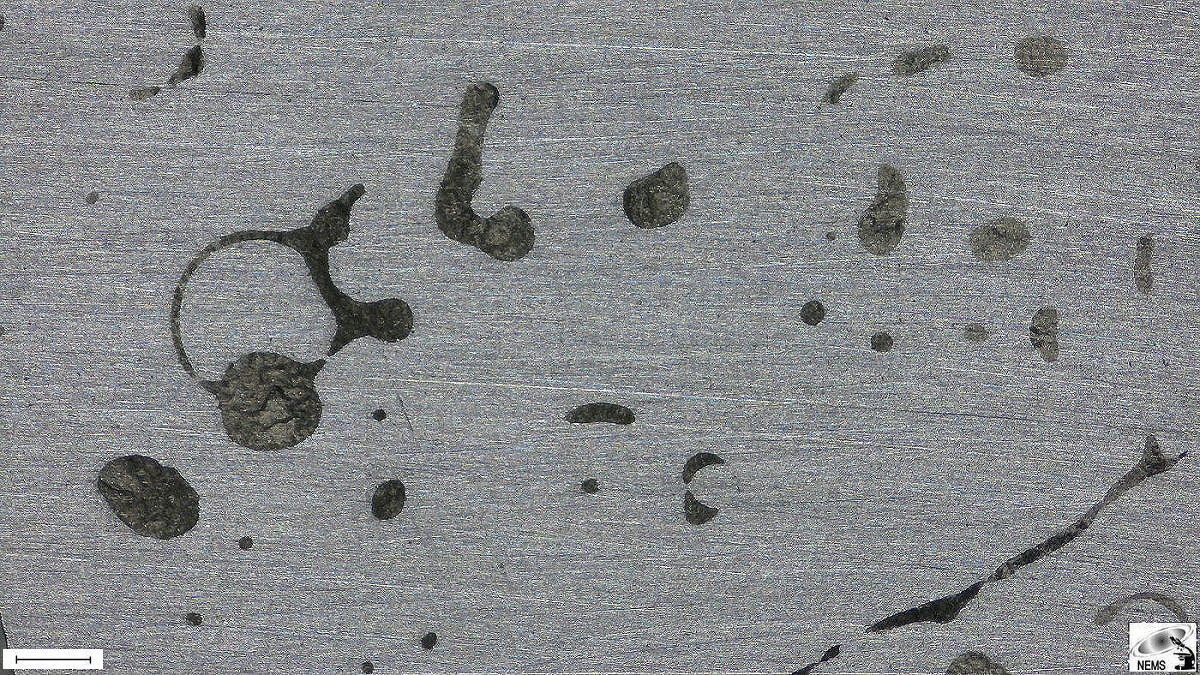
| Figure 2. Additional troilite droplets in the N’Goureyma iron meteorite. Scale bar=800 µm. |
| N'Goureyma, troilite droplets. |
| References • Buchwald, V. F. (1975). Handbook of Iron Meteorites. University of California Press (Vol. 3, detailed description of N’Goureyma, including chemistry, microstructure, troilite morphology, and sintering interpretation). • Meteoritical Bulletin Database (LPI). Entry for N’Goureyma (official classification, fall details, and references). • Kracher, A., et al. (various works on ungrouped irons and trace-element depletions). • Wasson, J. T., & Kallemeyn, G. W. (2002). The IAB iron-meteorite complex: A group, five subgroups, numerous grouplets, closely related, mainly formed by crystal segregation in rapidly cooling melts. Geochimica et Cosmochimica Acta, 66(13), 2445–2473 (context for ungrouped irons with anomalous chemistry). • Rubin, A. E. (various papers on shock reheating and troilite mobilization in irons). • Yang, J., & Goldstein, J. I. (studies on rapid cooling, martensitic textures, and plessite formation in iron meteorites). |
| Listing of Structures |